
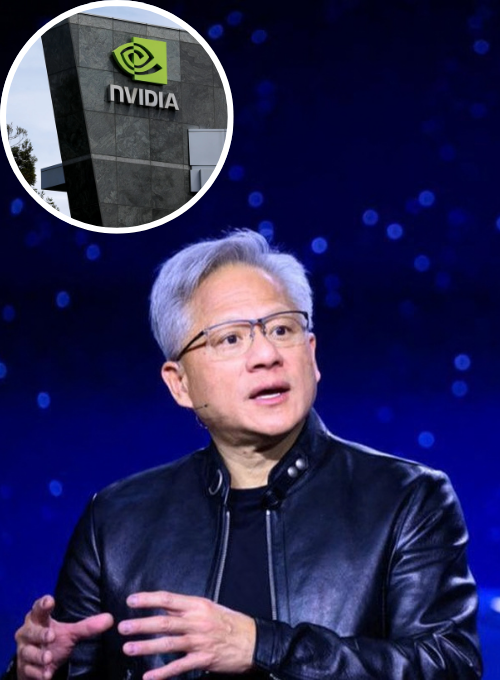


Jensen Huang, co-founder and chief executive of Nvidia, has flatly rejected warnings that artificial intelligence poses an extinction-level threat to humanity, dismissing such predictions as irresponsible and entirely without scientific grounding.
Huang pushed back against comments made on social media by Jacob Coxon, a former researcher at AI company Anthropic, who had claimed that AI could become superhuman and wipe out humanity within the decade. Huang was blunt in his response, placing the probability of that outcome at precisely zero and stating that 2030 would not mark the end of the world. Scaring people, he said, was both unnecessary and irresponsible.
Coxon’s remarks, which were echoed by two other Anthropic researchers, triggered a wider international debate about the pace of AI development and the adequacy of oversight. Reporting by the Guardian noted that Anthropic had published a threat intelligence report outlining how criminal actors, state-sponsored groups and others had attempted to misuse its AI models to design weapons and engineer dangerous pathogens.
Huang also challenged calls from within the AI industry for new safety regulation, suggesting the demands were less straightforward than they appeared. He argued that existing laws covering cybersecurity, product liability and contractual obligations were already sufficient to address most AI-related harms. His sharper point was that companies calling for new frameworks were, in effect, seeking to escape accountability under legislation that already applied to them. Apply those laws first, he argued, before allowing doomsday narratives to relieve anyone of the obligations already on the books.
The debate spans political fault lines in the United States. Anthropic chief executive Dario Amodei, OpenAI boss Sam Altman and Elon Musk have all called at various points for AI development to be slowed. President Donald Trump has dismissed those concerns as a hoax, arguing that any pause would hand strategic advantage to China. On the diplomatic front, US Treasury Secretary Scott Bessent confirmed that Washington and Beijing had agreed to establish an AI dialogue mechanism to help manage the technology’s potential risks.
Separately, the Tony Blair Institute published a paper warning that countries failing to keep pace with AI risked serious and compounding disadvantage, while cautioning that government institutions were poorly equipped to navigate the decisions ahead.