
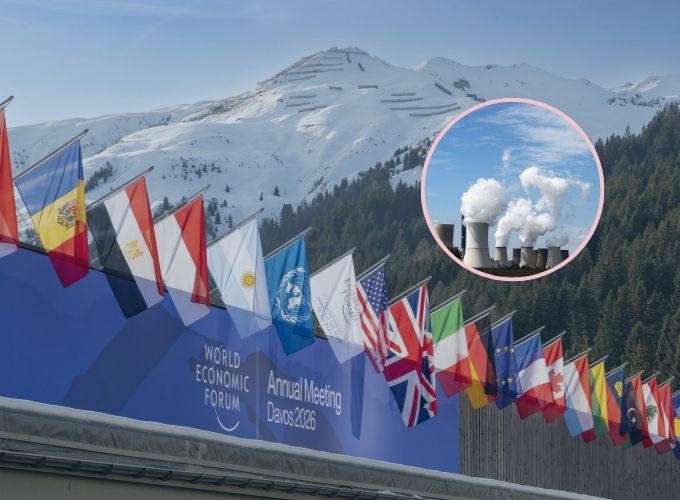


At this year’s World Economic Forum in Davos-Klosters, the energy transition is not being challenged in principle. What is being tested — sometimes uncomfortably — are its limits. Not political limits, but physical, financial and geopolitical ones.
The prevailing mood is not scepticism, but caution. Climate objectives remain broadly accepted across governments and boardrooms, yet there is a growing recognition that the pace, shape and cost of transition are far more constrained than earlier narratives suggested. Davos this year reflects a collective recalibration: less emphasis on where the world wants to end up, more attention on what can realistically be delivered along the way.
That shift is most visible in how energy is framed. Rather than standing alone as a climate issue, it is now discussed through the lenses of economic resilience, industrial competitiveness and security exposure. This is not a repudiation of ambition, but an acknowledgment that ambition does not automatically translate into infrastructure, affordable power or stable systems — especially in a more fragmented global order.
Renewables remain central to the conversation, but they are approached with fewer assumptions. Solar and wind are consistently described as increasingly competitive sources of energy, valued above all for their cost profiles. Their role in reducing long-term price volatility is widely accepted. At the same time, their limitations are discussed more openly than in past years. Grid congestion, long permitting timelines, storage costs and system balancing are no longer treated as secondary challenges that innovation will inevitably solve. They are recognised as binding constraints shaping what can be built, where and how fast.
This more grounded tone is inseparable from geopolitics. The energy transition is now unfolding in a world defined less by cooperation and more by strategic rivalry. For the United States, this has translated into a closer alignment between climate policy, industrial strategy and national security. Clean energy deployment is increasingly tied to domestic manufacturing, control over critical inputs and resilience against external shocks. Subsidies and trade measures are justified not only on environmental grounds, but as tools to secure long-term economic and strategic advantage.
China has taken a different tack in its Davos messaging, emphasising continuity, scale and reliability. Chinese officials have highlighted their central role in global clean-tech manufacturing and supply chains, implicitly reminding audiences that the transition as currently structured is deeply dependent on Chinese capacity. While diversification is widely discussed, there is an implicit acceptance that reducing these dependencies will be gradual, costly and politically complex.
For Europe, the discussions are perhaps the most delicate. European leaders continue to articulate strong climate ambitions, but there is a growing openness about the trade-offs involved. High energy prices, regulatory complexity and limited fiscal space are now openly acknowledged as constraints. The concern expressed in many sessions is not about abandoning climate goals, but about sustaining industrial competitiveness and social support through what is increasingly understood as a long and uneven transition.
This reassessment has softened earlier absolutism around energy pathways. While the long-term move away from fossil fuels remains a shared objective, there is greater acceptance that transition routes will differ across regions. Natural gas is discussed pragmatically as a transitional stabiliser in certain systems. Nuclear energy, largely sidelined in previous Davos cycles, has re-entered the conversation as a potential solution to baseload needs — particularly as electricity demand rises sharply due to data centres and AI infrastructure.
What anchors these debates is not ideology but immediacy. Climate-related insurance losses are affecting the bankability of infrastructure projects. Grid limitations are delaying investments that already have political backing and available capital. Competition for critical minerals is reshaping trade relationships and diplomatic priorities. At the same time, surging power demand from digital infrastructure is forcing governments to reassess assumptions about future consumption and capacity planning.
The energy-focused sessions still to come this week reflect this emphasis on execution rather than declaration. They are centred on practical questions: how quickly grids can be expanded, how supply chains can be made more resilient without triggering new trade conflicts, and how energy costs can be managed in economies already facing political and fiscal strain. Expectations for sweeping announcements are muted; progress is measured instead in coordination, alignment and incremental delivery.
Taken together, Davos suggests the energy transition is entering a more constrained phase. Not stalled, but shaped more clearly by infrastructure, markets and geopolitics than by aspiration alone. The limits being discussed here are not endpoints, but boundaries — reminders that the transition will be defined as much by what is possible at each stage as by where policymakers hope to arrive.
In that sense, the conversations in Davos are less about scaling back ambition than about grounding it. Energy is still central to the global agenda, but it is increasingly treated as a system to be managed rather than a vision to be declared — subject to pressures that can shift quickly, and outcomes that remain, by necessity, provisional.