


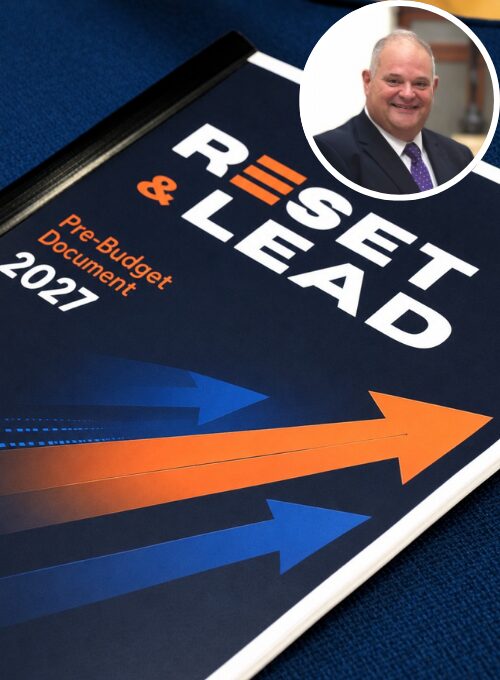
The Malta Chamber of Commerce, Enterprise and Industry today launched its Pre-Budget 2027 document, titled RESET and LEAD, setting out more than 150 proposals aimed at driving structural reform across Malta’s economy and institutions. The document was presented by The Malta Chamber CEO Dr Marthese Portelli, with a welcoming address by the President of The Malta Chamber William Spiteri Bailey.
A call for honesty and courage
Opening the press conference, President Spiteri Bailey said that Malta had reached a point where “adjusting around the edges is no longer enough,” and that the country needed “the courage to RESET what is not working and LEAD through the realities we face.”
While acknowledging Malta’s economic resilience, the President was direct about the challenges still facing the country: infrastructure under pressure, weak productivity, persistent bureaucracy, energy dependence and damaged trust in some institutions. “Not everything is well,” said the Malta Chamber, stressing that raising these issues is “not talking Malta down” but a necessary condition for fixing them: “You cannot fix a problem that you are unwilling to admit exists.”
The Malta Chamber linked Malta’s energy exposure directly to policy choices of recent years, arguing that had part of the substantial sums spent on indiscriminate fuel and energy subsidies instead been directed toward renewables, efficiency and storage, “Malta would today be less exposed to international energy shocks.” On the labour market, the Malta Chamber President called for a shift “from volume to value,” paired with a more efficient work permit system so that businesses can make better use of the workers already in Malta.
Governance featured prominently in Spiteri Bailey’s address, who insisted that institutions “exist to serve the people – not Governments, not political parties, not individuals,” and called for regulators to regulate, enforcement authorities to enforce and courts to deliver justice within a reasonable time. “Good governance is economic policy,” said President Spiteri Bailey, warning that “trust has economic value. And the loss of trust has an economic cost.”
The President Spiteri Bailey closed by framing RESET and LEAD as a national, not a partisan, agenda: “This is not a Labour position. It is not a Nationalist position. It must be Malta’s position.”
150+ proposals for structural change
Presenting the substance of the proposals, CEO Dr Marthese Portelli set out The Malta Chamber’s case that the “time for incremental adjustments has passed,” pointing to an uncomfortable reality: too many critical proposals raised in previous years remain unaddressed, delayed or stalled.
The presentation grounded this call for reform in economic data. Between 2015 and 2025, Malta’s Gross Value Added grew by 81.9%, but the Malta Chamber’s analysis shows this growth was driven overwhelmingly by an expanding workforce (68.9%), with only a modest contribution from higher value-added sectors (9.9%) and productivity improvements (3.1%). Equally important to that, The Malta Chamber noted that compensation growth has consistently outpaced labour productivity growth in recent years and that government debt has risen sharply since 2019 while productivity per person employed has remained broadly flat – trends projected to continue into 2026, with compensation set to rise 4.4% against productivity growth of just 0.1%, compared to a projected EU average of 1.0%.
The Malta Chamber Pre-Budget 2027 Document is based on six pillars:
• Reforms that initiate structural change
• Transformations prioritising core, value-added productivity
• Measures promoting Excellence and value-add replacing volume-driven expansion
• Standards to reshape business and institutional culture
• Execution anchored in firm legislative foundations and a fair, level playing field
• Good governance to build trust, uphold the rule of law, and ensure efficient use of national resources
The 150+ proposals are organised into two broad sections.
The first addresses economic and sectoral priorities which need to be executed by end-2027, including funding and investment support and taxation; human resources, education and skills; technology and AI adoption; infrastructure (spatial planning and construction, mobility, energy, water and waste management); value enhancement in tourism; addressing state-induced market distortions and unfair competition; Malta’s island-state and EU-related challenges and internationalisation.
The second section focuses on national and institutional reforms kickstarting in 2027, whose execution would spread over the rest of the legislature; covering planning and construction, mobility and transportation, energy, waste management, digital transformation, education and skills alignment, public procurement, pensions reform and public good governance and parliamentary reform.
A shared national agenda
The contribution by The Malta Chamber provides an evidence-based call for Government to move from strategy to execution because “The Malta Chamber has spoken about these things for long enough. Now we need the courage to RESET, LEAD and above all, execute.”
You Might Also Like
Latest Article
THE MALTA CHAMBER LAUNCHES PRE-BUDGET 2027 PROPOSALS: ‘RESET AND LEAD’
The Malta Chamber of Commerce, Enterprise and Industry today launched its Pre-Budget 2027 document, titled RESET and LEAD, setting out more than 150 proposals aimed at driving structural reform across Malta’s economy and institutions. The document was presented by The Malta Chamber CEO Dr Marthese Portelli, with a welcoming address by the President of The … Continued
|
14 September 2026
Written by Kim Vucinovic Cutajar

ASTON MARTIN LAUNCHES FIRST STREET-LEGAL MOTORCYCLE, THE AMB 002 ROADSTER, LIMITED TO 300 UNITS
|
14 September 2026
Written by Yannick Pace

AUTOPILOT’S DEEPSEEK PORTFOLIO RETURNS 69.67% SINCE SEPTEMBER, BEATING S&P 500 AND GPT RIVAL
|
11 September 2026
Written by Yannick Pace


EC ENGLISH ABRUPTLY HALTS NEW STUDENT ARRIVALS WORLDWIDE
|
11 September 2026
Written by Yannick Pace