

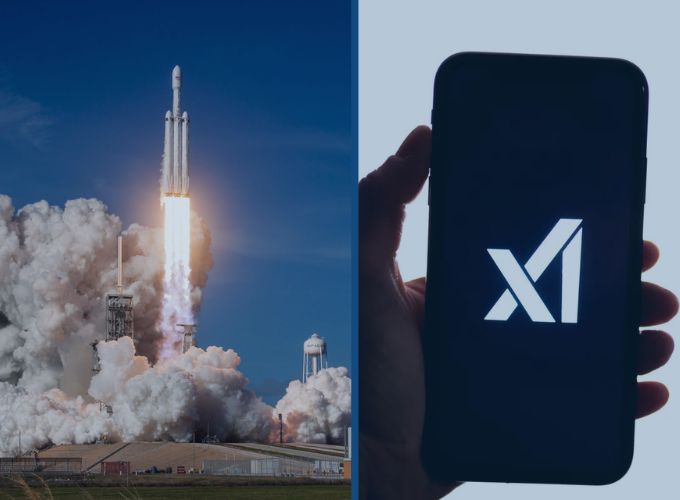
SpaceX has acquired artificial intelligence start-up xAI in a transaction that values the combined business at $1.25 trillion, marking a major consolidation across Elon Musk’s private technology empire.
Under the deal, SpaceX is paying $250 billion to acquire xAI, based on a recent funding round that valued the two-year-old AI company at around $230 billion. The transaction also reflects a sharp increase in SpaceX’s own private valuation, which has been marked up to $1 trillion, driven in part by rising revenues from its Starlink satellite broadband business.
SpaceX had previously been valued at roughly $800 billion in a recent secondary share sale. By combining the two businesses, Musk is bringing together key components of his long-term plan to compete in the global race to develop advanced artificial intelligence systems.
Executives told investors that shares in the combined company would be priced at $527, with xAI shareholders receiving SpaceX stock at an exchange ratio of roughly seven to one. The structure effectively folds xAI fully into SpaceX, aligning AI development directly with the company’s space and satellite operations.
The merger comes as SpaceX continues to explore plans for an initial public offering, potentially as early as June. If it proceeds, the IPO could raise up to $50 billion, which would make it the largest stock market flotation on record. However, analysts have noted that the complexity of the xAI acquisition could complicate the timeline for a public listing.
Musk has repeatedly argued that the future of artificial intelligence will be constrained by energy availability on Earth. He has positioned space-based data centres as a long-term solution, citing the environmental and infrastructure challenges of scaling AI using terrestrial power sources alone. According to Musk, orbital data centres could eventually provide the capacity required to train and operate increasingly powerful AI models.
xAI has been competing with rivals such as OpenAI and Meta, all of which have been investing heavily in chips, data centres and computing infrastructure. By integrating xAI into SpaceX, Musk is tying AI development directly to launch capabilities, satellite deployment and orbital infrastructure.
The deal also follows a broader pattern of consolidation across Musk’s businesses. Last year, xAI was merged with his social media platform X, enabling tighter integration between AI development and real-time data from the platform.
Beyond AI, Musk continues to run electric vehicle maker Tesla, brain–computer interface company Neuralink and tunnelling venture The Boring Company. Investors have increasingly speculated that further integration across these businesses could follow as Musk pursues a more unified long-term strategy.
You Might Also Like

Latest Article
Chiliz Unveils 2030 Manifesto: Charting the Future of SportFi with Real World Assets, DeFi Integration, and US Market Re-Entry
Marking the company’s eighth anniversary, the pioneer of sports blockchain announces ambitious roadmap to unlock $1 trillion sports industry opportunity through tokenization, enhanced Fan Token economics, and institutional-grade infrastructure. LONDON, 3 January 2025 — The Chiliz Group, the world’s leading blockchain provider for the sports and entertainment industry, today published its Chiliz 2030 Manifesto, … Continued
|
3 February 2026
Written by Hailey Borg
SpaceX Acquires xAI In $1.25tn Deal To Consolidate Musk’s Empire
|
3 February 2026
Written by MeetInc.
WasteServ Confirms €75m Investment In New Organic Waste Energy Plant
|
2 February 2026
Written by MeetInc.