
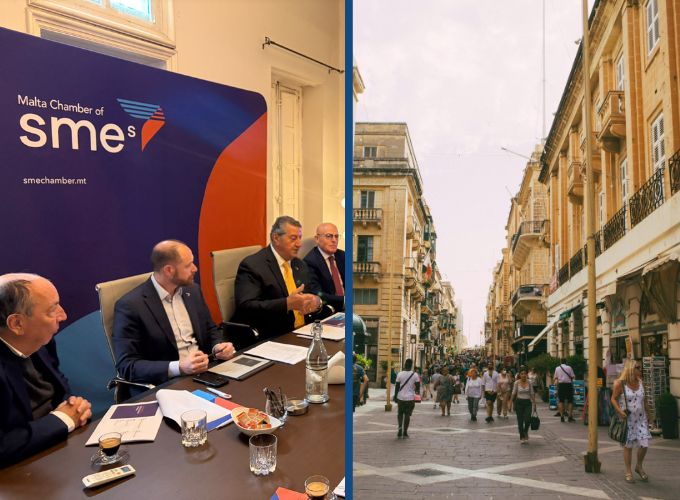


The festive season failed to deliver the expected boost for many Maltese businesses, with nearly half reporting a drop in holiday sales, according to the latest Business Performance Survey published by the Malta Chamber of SMEs.
The survey shows that 44% of respondents experienced lower turnover during the 2025 festive period compared to the previous year, while just 26% recorded an increase. A further 30% said sales remained unchanged, pointing to a subdued Christmas period at a time traditionally relied upon to offset weaker months earlier in the year.
While festive performance can fluctuate from year to year, the Chamber’s findings suggest this was not simply a seasonal blip. The weaker Christmas trading coincides with a broader deterioration in business sentiment, with a clear majority of SMEs now believing Malta is moving in the wrong direction.
According to the survey, around two-thirds of respondents said the country is heading in the wrong direction, a view that has strengthened steadily over the course of 2025. By contrast, fewer than four in ten believe Malta is moving in the right direction, underlining a growing disconnect between headline economic growth and how businesses perceive conditions on the ground.
Respondents pointed to a range of factors driving this pessimism, with cost of living and affordability topping the list. Concerns about quality of life, political leadership and direction, and infrastructure and national planning also featured prominently, reflecting anxieties that extend beyond immediate business performance.
The survey suggests that pressure on consumers is now feeding more visibly into retail and service-sector activity. While some businesses reported modest gains earlier in the year, the Christmas period appears to have exposed increasing price sensitivity, with spending becoming more cautious and concentrated. Notably, Black Friday outperformed late December as the strongest trading day for many respondents, hinting at a shift towards discount-driven consumption rather than seasonal generosity.
Beyond the festive period, the wider picture for 2025 is one of uneven and fragile growth. Although 43% of businesses reported higher overall turnover during the year, 31% saw no change, and 26% experienced a decline. Profitability tells a similar story: most firms reported profits either remaining flat or declining, with only around a quarter saying they became more profitable compared to 2024.
Rising costs continue to erode margins. The most commonly cited drivers of price increases were wage and salary costs, followed by higher costs of imported products and overhead expenses excluding wages. Transport costs, regulatory compliance, rent and bank charges were also frequently mentioned, reinforcing the view that businesses are absorbing a growing cost burden even when revenues hold up.
Labour shortages remain a persistent concern. Many respondents said difficulties in attracting and retaining skilled workers continue to constrain growth, particularly in sectors reliant on specialised labour. At the same time, increased competition — including what some businesses describe as unfair or illicit trading — is placing further pressure on prices and margins.
This combination of softer demand, higher costs and structural challenges appears to be weighing heavily on confidence. When asked whether the next 12 months represent a good time to invest, the dominant response was uncertainty. A majority of respondents said they were “not sure”, while only around one in five felt confident enough to answer yes. That hesitation, rather than outright pessimism, may be one of the survey’s more consequential findings.
Looking ahead, expectations remain muted. Just over half of respondents believe 2026 will be broadly similar to 2025, while 28.5% expect conditions to improve and 19.6% anticipate a worse year ahead. The balance suggests stability rather than optimism — a far cry from the confidence typically associated with sustained economic expansion.
Taken together, the findings point to a business community that is still operating, still growing in parts, but increasingly cautious. A weak Christmas on its own might have been absorbed. Coming at the end of a year marked by rising costs, labour shortages and mounting concerns about the country’s direction, it has instead reinforced a sense of unease.
For many SMEs, the festive period is more than just a sales spike. It is a test of consumer confidence — and this year, that test appears to have been failed.