
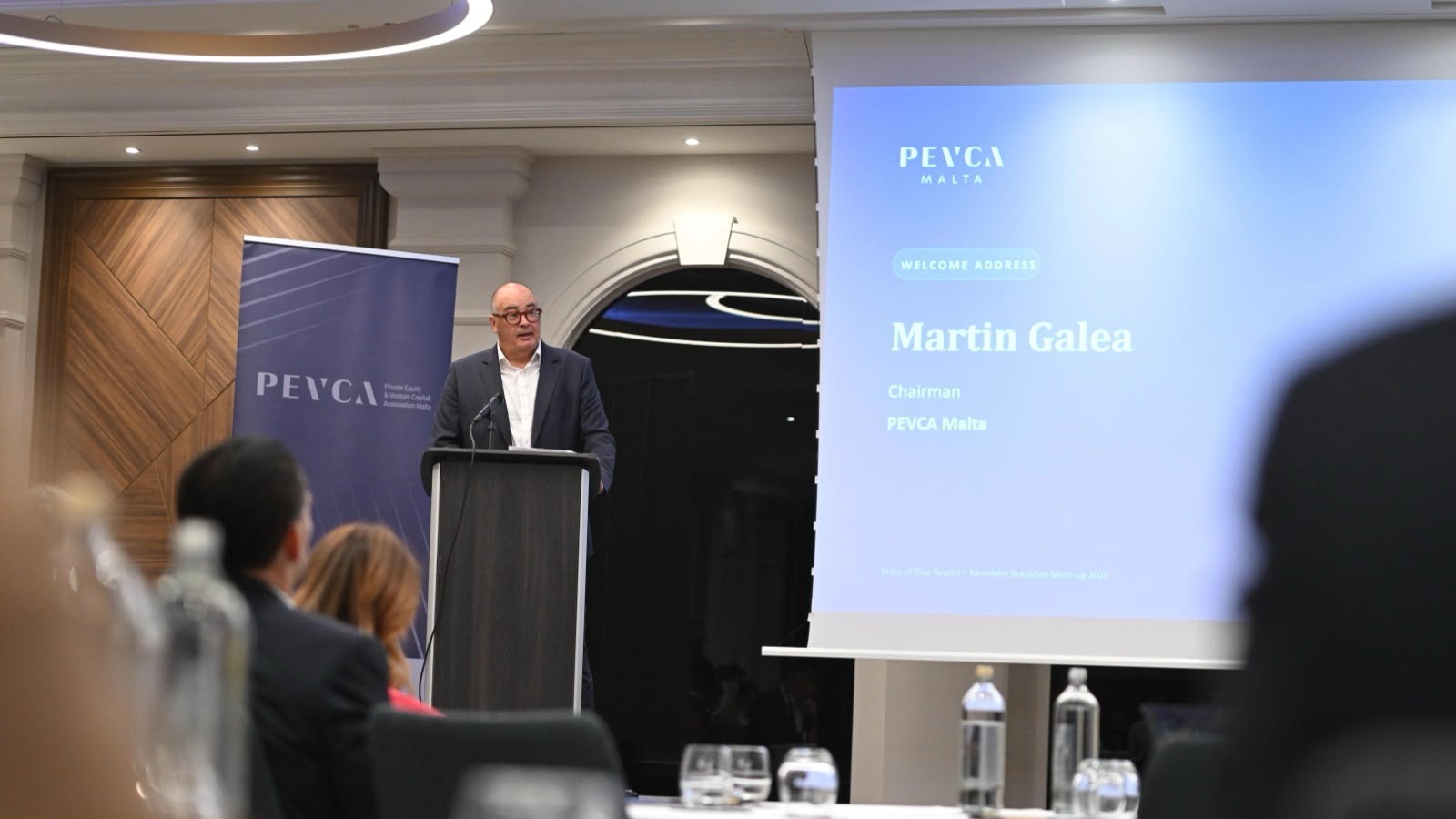


Malta should build its own position in private equity and venture capital rather than imitate Luxembourg or Ireland, the Malta Private Equity and Venture Capital Association said on Friday, as it launched its first country report at the Hilton Malta.
The State of Play Report 2026, commissioned by PEVCA Malta, looks at the island as a wider ecosystem rather than a straightforward fund domicile. Its four tax and investment reforms are pitched as material for debate, not settled policy, in what the association frames as a push for "genuine economic substance".
Opening the conference, chairman Martin Galea said the goal was to attract real activity, while conceding the market would take time to mature. He cast the report as a starting point for a better-informed conversation about where opportunity sits and what stands in the way. "Dare we think big?" he asked. "Perhaps the more suitable question is: dare we not?"
The recommendations come from Gavin Ryan, who worked for 15 years as a mid-cap private equity fund manager. He calls for zero capital gains tax for local investors in private equity and venture capital funds, intended to steer money away from property; a government-backed fund of funds run by independent professionals; the 15 per cent income tax rate to apply to qualifying fund managers whatever their ownership stake; and no tax on carried interest for Malta-resident fund managers.
The report is candid about how small the opportunity is. Malta counts roughly 3,000 companies in the EU's small and medium category, and earlier figures suggested as many as 300 might suit private equity investment. Yet when the government's company database was tested against three plausible lower mid-cap approaches, labelled "quality only", "good but overleveraged" and "smaller good company", only 35, 67 and 8 firms qualified, around 100 prospects between them. The authors judge the scope for a Maltese SME mid-cap market "extremely limited", see "almost no scope" for generalist lower mid-cap funds, and point instead to thematic vehicles covering areas such as energy efficiency or digitalisation.
On the plus side, the report says the ingredients are already present: EU membership, English, a common-law system and a financial services sector employing 14,745 people, or 2.5 per cent of the population, against Luxembourg's 8 per cent. The gaps, it argues, are in domestic capital, fund-manager presence and tax competitiveness.
FinanceMalta's George Vella described the sector as an area where Malta could grow. He said the country remains the only EU member state without a European Investment Bank-supported fund of funds, and that Maltese development banks have now been accredited to take on that role.