
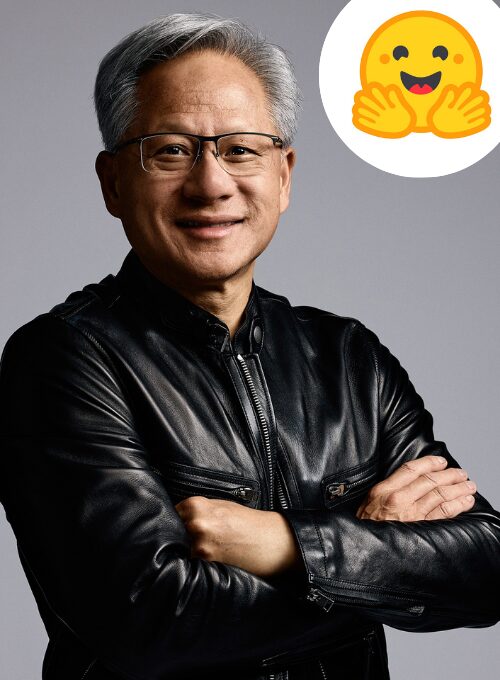


Nvidia has agreed to buy Hugging Face, the open-source AI model platform, for 13 billion dollars, marking the chip giant’s largest outright acquisition to date and its most significant move yet to extend its reach across the entire AI industry.
The deal comfortably eclipses Nvidia’s previous biggest purchase, the 6.9 billion dollar acquisition of networking company Mellanox in 2020 and arrives at a striking premium to the valuation Hugging Face was working with not long ago. The platform turned down a 500 million dollar investment from Nvidia late last year, partly to avoid any single dominant investor, at a self-assessed valuation of around 7 billion dollars. It has now agreed to sell outright for nearly double that figure.
Nvidia’s stated goal for the deal is to accelerate the spread of open-weight AI models: systems whose underlying design is publicly available and can be downloaded, customised and run on private hardware, in contrast to proprietary offerings from the likes of OpenAI and Anthropic. Jensen Huang, Nvidia’s chief executive, argued in a statement that open weights allow start-ups, universities and public institutions to build on advanced AI capabilities without having to train every model from scratch or pay frontier-model prices for routine tasks.
Hugging Face, named after a popular emoji, hosts three million primarily open AI models, roughly 500,000 datasets and one million AI applications. More than 200,000 companies use the platform to discover AI tools and over 18 million developers work within its ecosystem. Nvidia has pledged to keep the platform open and to maintain the Hugging Face brand.
The acquisition gives Nvidia, already the world’s most valuable company at a reported 5.4 trillion dollars, control over one of the most influential distribution channels in AI. Commercially, the logic is clear: a broader proliferation of open models generates fresh demand for Nvidia’s chips while reducing its reliance on a small cluster of large customers, some of whom are also building their own processors.
Nvidia hopes to close the transaction by 2027, though it is widely expected to attract scrutiny from competition regulators. Justin Boitano, Nvidia’s vice-president of enterprise AI, expressed confidence that regulators would ultimately view the outcome favourably.
The announcement also lands as Nvidia has been consistently positioning itself as a champion of open AI development. Huang put his name to a letter in July calling on the United States to support an open AI ecosystem, arguing that AI leadership should not be measured solely by the strength of any single proprietary model.