

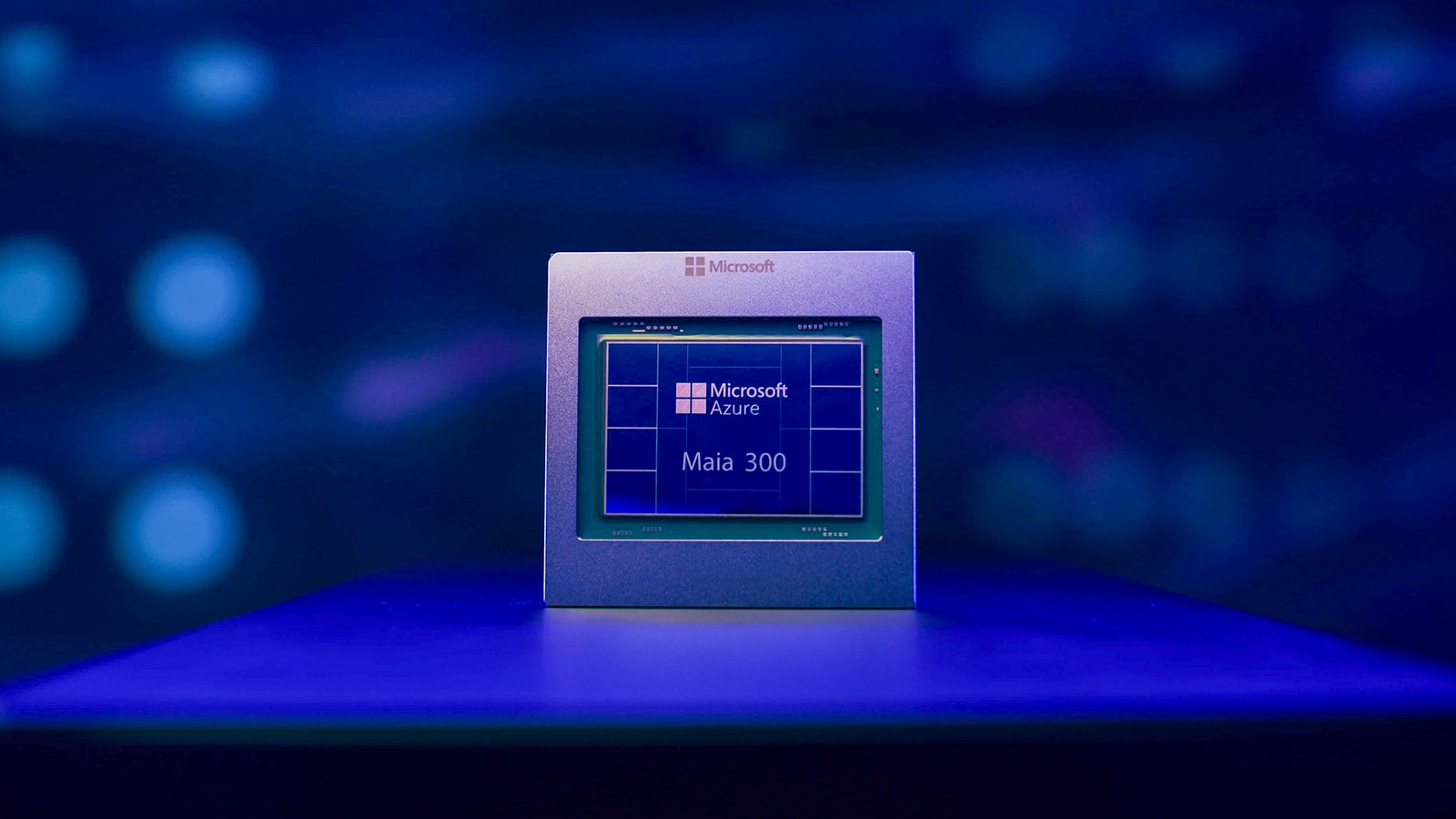


Microsoft has unveiled the Azure Maia 300, its latest custom AI chip, as part of a broader effort to reduce its dependence on processors supplied by Nvidia and AMD.
The chip was announced at the OCP Global Summit 2026 in San Jose and will sit alongside the existing Maia 200 and Maia 100 in what Microsoft describes as multigigawatt deployments beginning next year. The company intends for the Maia family to serve as the primary AI inference system for Microsoft products and services.
On the performance side, Microsoft claims the Maia 300 delivers 40% more tokens per megawatt than leading GPU-based systems, a metric that points squarely at Nvidia. A 96-chip rack configuration, the company added, offers seven times the rack-scale token throughput of its predecessor, the Maia 200. Tokens are the fundamental unit of measurement in AI processing, representing fragments of words, images, and video, so greater token efficiency per unit of power translates directly into a more cost-effective AI rack.
The Maia 200 is already doing heavy lifting inside Microsoft's production environment. It currently handles workloads for Microsoft 365 Copilot, OpenAI models, Microsoft's own MAI models, and various open-source models. Microsoft says the chip delivers 1.7 times more tokens per watt than competing GPU-based systems for AI features embedded in Teams, Copilot, and its Cowork software.
Microsoft is far from alone in this direction. Amazon, Google, and Meta, along with AI labs OpenAI and Anthropic, are each at various stages of developing or deploying their own custom silicon. The logic is consistent across all of them: proprietary chips reduce exposure to any single supplier and allow companies to tailor hardware precisely to their workloads.
That presents a genuine long-term challenge for Nvidia, which has historically derived more than half of its quarterly revenue from hyperscalers. Amazon and Google have already extended their ambitions further, offering their custom chips to third-party customers, with Amazon also exploring chip sales for installation in customer-owned data centres rather than cloud facilities.
That said, Microsoft and its peers are unlikely to walk away from Nvidia entirely. Enterprise customers continue to demand access to a range of chips for different tasks, and Nvidia's processors remain the most sought-after in the market. Custom silicon is a hedge, not a replacement, at least for now.