

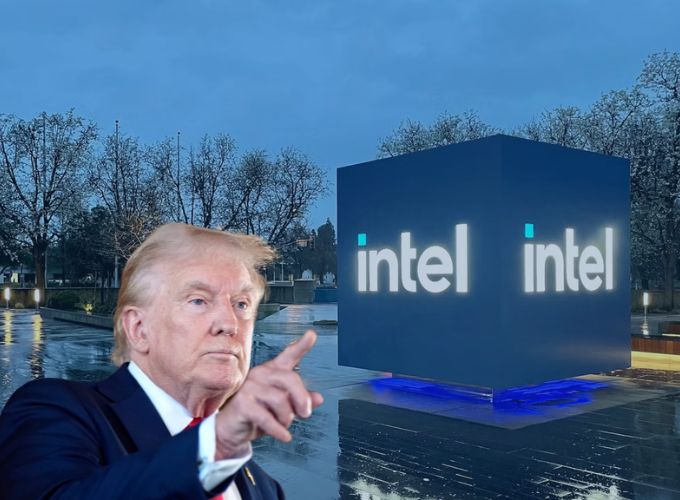


The Trump administration is considering taking a roughly 10% stake in Intel Corporation, a move that would make the U.S. government the largest shareholder in the struggling chipmaker. The talks, still at an exploratory stage, reflect Washington’s increasing willingness to take direct ownership in critical industries to secure supply chains and limit reliance on China.
According to people familiar with the matter, the White House is weighing whether to convert part or all of Intel’s promised $10.9 billion in Chips and Science Act grants into equity. Intel is among the biggest beneficiaries of the 2022 law, which allocated subsidies to expand U.S. semiconductor manufacturing and research. At Intel’s current market value, a 10% stake would be worth about $10.5 billion. Bloomberg, which first reported the discussions, noted that no final decision has been made and that the scope and timing of any deal remain uncertain.
The proposal comes at a pivotal moment for Intel. Once the undisputed leader in semiconductor technology, the company has spent the past decade losing ground to rivals such as Taiwan Semiconductor Manufacturing Co. (TSMC) and Samsung. Manufacturing delays, strategic missteps, and stiff global competition have weakened its position. In recent months, Intel has struggled to meet production goals despite heavy federal support, fueling concern in Washington about America’s long-term ability to produce cutting-edge chips domestically.
President Donald Trump has repeatedly pointed to Intel as both a national security priority and a symbol of U.S. industrial decline. Earlier this summer, he publicly criticized Intel CEO Pat Gelsinger for what he called “weak leadership,” saying the company had “squandered taxpayer money” while continuing to trail foreign competitors. The comments highlighted tensions between the administration’s push for semiconductor independence and the private sector’s uneven performance in delivering results.
The possibility of a government equity stake is not without precedent. Last month, the Defense Department announced it would acquire a $400 million preferred equity stake in MP Materials Corp., a rare-earth producer critical to U.S. defense supply chains. That deal, also funded through industrial policy initiatives, made the Pentagon the company’s largest shareholder and underscored Washington’s new approach of using ownership to secure strategic assets.
Intel’s grants under the Chips Act were designed to be disbursed gradually as the company achieved agreed-upon milestones. The company has so far received $2.2 billion, but it remains unclear whether those funds would be rolled into any equity arrangement. Nor is it clear whether the government would pursue similar deals with other chipmakers, although officials have floated the idea of expanding equity conversions beyond Intel.
Markets reacted swiftly to the news. Intel’s shares, which had been down 1.3% in Monday trading, rallied sharply last week after reports of government interest surfaced, recording their best weekly gain since February. Investors appear to see the potential stake as both a vote of confidence and a financial backstop for the embattled company.
For the Trump administration, the stakes go beyond shareholder value. Securing U.S. control over leading-edge semiconductor production has become a geopolitical imperative as competition with China intensifies. A direct investment in Intel would mark a dramatic escalation in that effort — one that blends industrial policy with outright ownership in a sector seen as vital to America’s technological and military edge.
You Might Also Like