
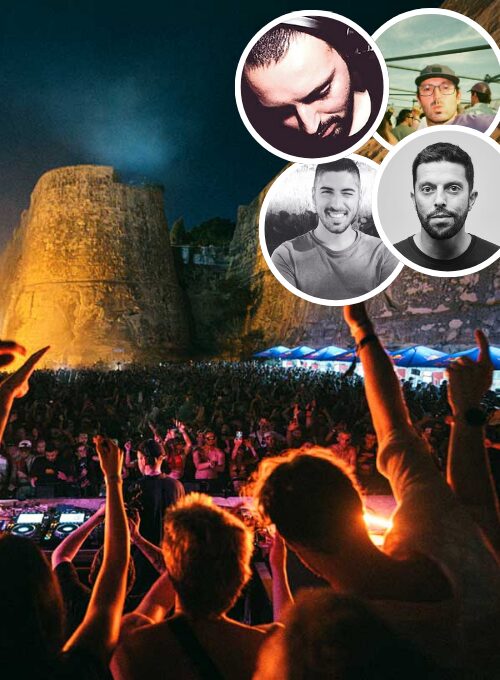


Ten years ago, four Maltese music promoters who had effectively been competing with one another sat down together with an idea.
Today, the festival that emerged from that conversation is sold out, attracts people from more than 80 countries to Malta, features more than 95 acts across nine-plus stages, has launched events as far away as Australia and has spawned a second festival of its own.
For a homegrown Maltese entertainment brand, the story of Glitch Festival is a remarkable one.
As Glitch celebrates its tenth anniversary this week, perhaps its greatest achievement is not simply that it has survived for a decade. It is that somewhere along the way, Glitch stopped being a Maltese electronic music festival trying to attract an international audience and became an international electronic music festival that happens to have been born in Malta. (Glitch Festival)
Behind it are Cain Farrugia, Andrew Grech, Karl Attard and Kevin Ellul, four figures who had already spent years working within Malta’s electronic music scene before joining forces.
The origins are refreshingly uncorporate.
Farrugia recalled in a 2017 interview that he and Grech had been organising their own nights when Attard and Ellul approached them for a meeting in March 2015. At the time, the two sides could reasonably have been described as competitors.
Instead of continuing to compete for essentially the same audience, they began discussing the limitations of Malta’s club-night model. Bringing one major international artist to the island was expensive, while the size of the local market inevitably limited how far an individual event could grow.
What if, instead, they pooled their audiences, experience and contacts and built something considerably bigger?
That conversation became Glitch.
The first festival arrived in 2016 and, from the outset, the ambition was unusually international for a locally produced event. Rather than simply booking recognisable electronic acts and building a festival around them, Glitch developed a distinct musical identity rooted in techno, house and the various subgenres surrounding them.
That distinction matters.
Festival businesses are ultimately brand businesses. Artists can appear at dozens of festivals during a European summer. Venues can be replicated. Stages can be built. What is considerably harder to manufacture is an identity strong enough that audiences begin travelling specifically for the festival itself.
Glitch appears to have crossed that threshold.
Its tenth-anniversary edition, taking place between 12th and 15th August 2026, is officially sold out. More than 95 artists are appearing across, more than nine stages, while the organisers say attendees are arriving from over 80 countries. (Glitch Festival)
The programme has also grown far beyond two nights in a field.
Glitch now stretches across four days, beginning beneath Valletta’s historic fortifications, moving to its main festival home at Gianpula Village and extending into after-hours events, rooftop and pool experiences, boat parties and a closing party. (Glitch Festival)
The line-ups tell another part of the story.
Over the years, Glitch has brought some of electronic music’s most respected names to Malta, while repeatedly bringing back artists who have become closely associated with the festival. Berlin techno heavyweight Ben Klock, for example, performed at the inaugural 2016 edition and, according to Glitch, has now appeared across five editions – more than any other artist. (Glitch Festival)
Perhaps an even clearer indication of Glitch’s standing came through its relationship with Boiler Room, one of the most influential global platforms in electronic music culture.
Boiler Room’s first Malta broadcast came from Glitch in 2019. It subsequently returned, including for the 2024 festival, placing sets recorded in Malta before a worldwide online audience. One 2024 Glitch performance, VTSS b2b KI/KI, has since generated more than two million views on Boiler Room’s YouTube channel alone. (BOILER ROOM)
That international recognition is important because Glitch’s success is not simply a story about getting foreign DJs to Malta.
Increasingly, it is about taking a Maltese festival brand abroad.
In 2025, Glitch made its Australian debut in Melbourne in partnership with Australian events company Untitled Group. It returned to Melbourne in April 2026, with the event staged at PICA.
Europe is becoming part of that expansion too.
Glitch has developed a collaboration with Amsterdam-based electronic music platform Intercell, which is now in its third year at the Malta festival. In October 2026, the relationship goes in the other direction, with Intercell x Glitch taking place during Amsterdam Dance Event, one of the most important annual gatherings in the global electronic music industry. (Intercell Events)
For a brand created on an island of little more than half a million people, there is something significant about that reversal.
Glitch originally needed the international electronic music circuit to build its festival in Malta. Ten years later, the Glitch name itself is travelling internationally.
And the founders haven’t stopped at Glitch.
Their other major development has been Dalma Festival, a darker, more specifically techno-focused winter event held at the Malta Fairs and Conventions Centre in Ta’ Qali.
Dalma’s inaugural edition arrived in 2023, with its second edition following in December 2024. That second festival featured names including Amelie Lens, Ben Sims, Dave Clarke, DVS1, Oscar Mulero, I Hate Models, Paula Temple, SNTS and Speedy J. (WhatsOn Malta)
Dalma returns on 4th and 5th December 2026, once again at MFCC, giving the team something strategically important: another substantial festival property outside Glitch’s traditional August window. (Dalma Festival)
From a business perspective, that may be one of the most interesting parts of what Glitch has become.
What started as a festival is gradually developing the characteristics of a broader entertainment and cultural brand: multiple festival properties, international editions and collaborations, recurring relationships with artists and promoters, digital content and a recognisable identity capable of travelling independently of Malta.
There is also a wider Maltese success story here.
Malta has spent years positioning itself as a destination for events, entertainment and music tourism. But there is an important difference between importing an international event concept into Malta and creating intellectual and cultural property in Malta that people overseas begin recognising in its own right.
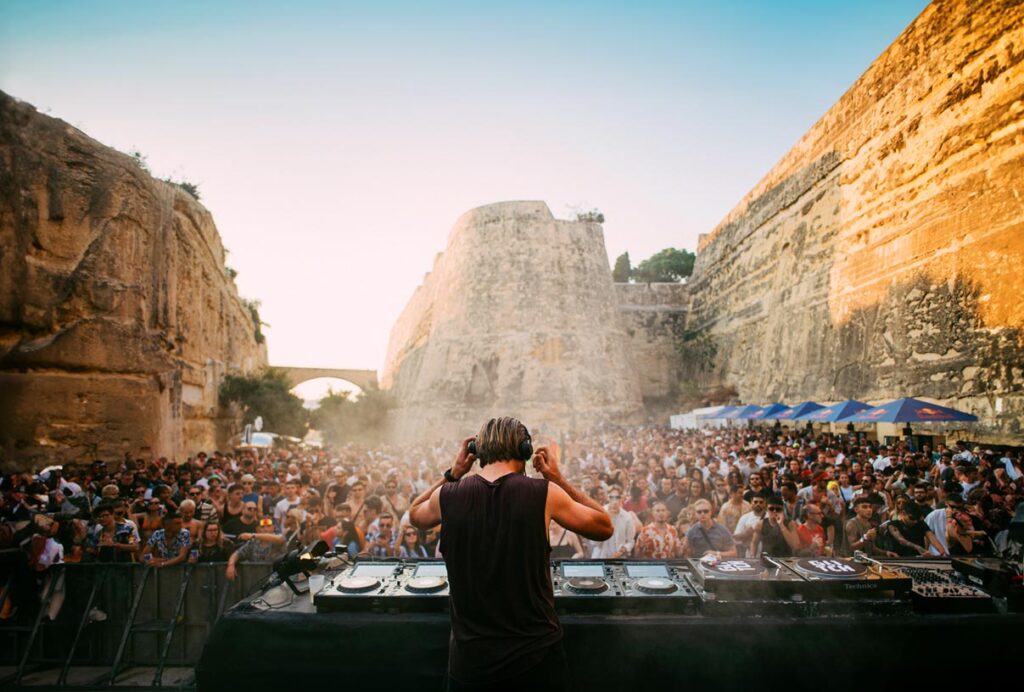
Glitch belongs firmly in the latter category.
The founders themselves have remained relatively understated considering the scale of what they have built. In an industry where personalities can sometimes become larger than the events themselves, Glitch has generally allowed the festival, its visual identity, its artists and its community to occupy centre stage.
That may partly explain its longevity.
Electronic music has changed considerably since 2016. Artists have risen and disappeared, genres have moved in and out of fashion, social media has transformed festival culture and the international events business endured the existential disruption of the pandemic.
Glitch has had to evolve alongside all of it.
The 2026 line-up bears little resemblance to what a cutting-edge electronic festival might have programmed a decade ago. Yet the underlying proposition remains recognisable: serious electronic music, ambitious production, distinctive Maltese settings and an audience that increasingly regards travelling to Malta in August as part of the international festival calendar.
That last point is perhaps the real measure of what Farrugia, Grech, Attard and Ellul have achieved.
Plenty of successful events take place in Malta.
Far fewer Maltese events become brands recognised outside Malta.
Fewer still reach the point where they can put on an event on the other side of the world and expect the name above the door to mean something.
Glitch has.
Ten years after four promoters decided they might achieve more by working together than competing against each other, their festival is sold out, people from more than 80 countries are travelling to Malta for its anniversary edition, a second festival is established on the local calendar and the Glitch name is appearing in Melbourne and Amsterdam.
For a project that started with a Saturday afternoon meeting between four people in March 2015, that is quite a journey.
Perhaps the most exciting part of the Glitch story is that, ten years on, it increasingly feels less like the conclusion of Malta’s most successful homegrown electronic festival experiment and more like the beginning of what an international Maltese festival brand could become.
Discover. Connect. Meet.
Follow MeetInc for more stories about the Maltese founders, entrepreneurs and businesses making their mark at home and internationally.
You Might Also Like
Latest Article
TEN YEARS ON: HOW FOUR MALTESE PROMOTERS TURNED GLITCH INTO AN INTERNATIONAL FESTIVAL POWERHOUSE
Ten years ago, four Maltese music promoters who had effectively been competing with one another sat down together with an idea. Today, the festival that emerged from that conversation is sold out, attracts people from more than 80 countries to Malta, features more than 95 acts across nine-plus stages, has launched events as far away … Continued
|
13 August 2026
Written by Kim Vucinovic Cutajar

CALL HER DADDY HOST, ALEX COOPER RAISES FUNDS AT $500 MILLION VALUATION
|
13 August 2026
Written by Yannick Pace

EXPERIMENTAL MAGLEV TRAIN STOPS WITHIN 200 METRES AFTER HITTING 800 KM/H IN RECORD TEST RUN
|
13 August 2026
Written by Yannick Pace