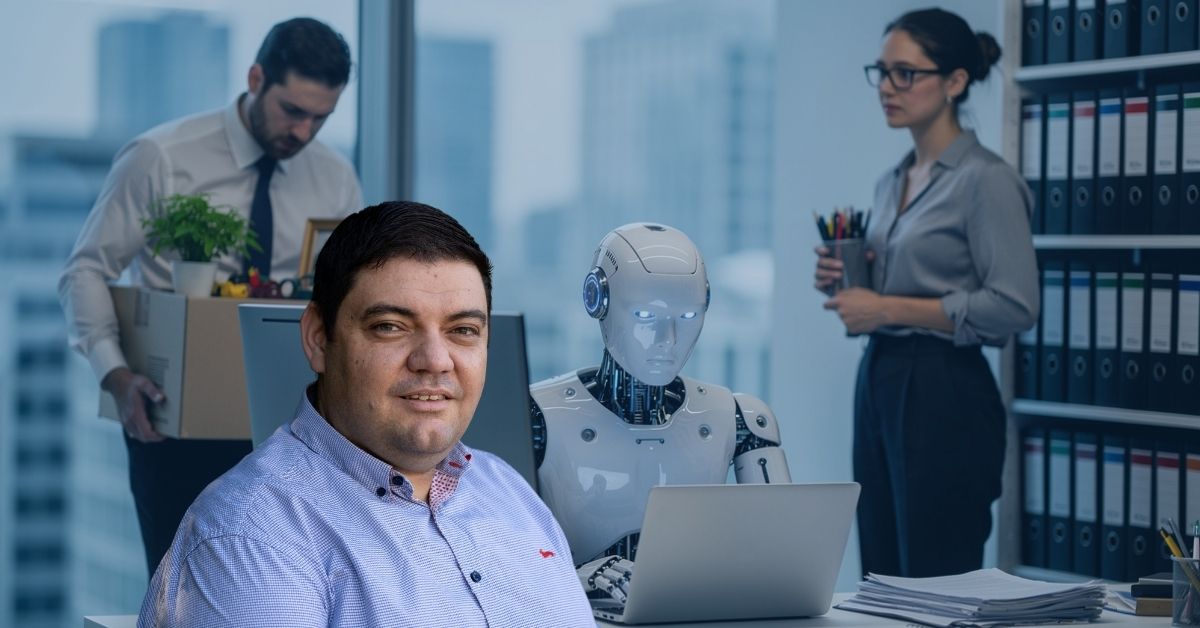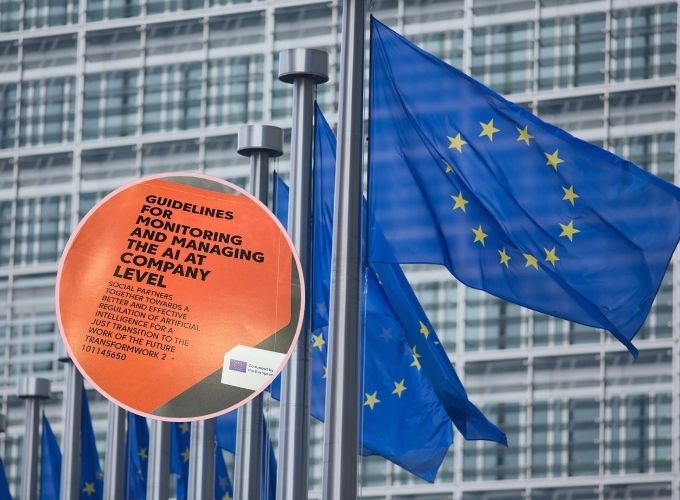


I spent the past few days at the TransFormWork 2 conference, a European forum on artificial intelligence and the future of work, where Malta was represented by The Malta Chamber and the General Workers’ Union. Policymakers, employers and worker representatives gathered to grapple with what comes next. This was not the usual AI conversation. There were no grand promises about limitless productivity or utopian futures — only a palpable anxiety that we may all become redundant, one job at a time. The emphasis was constant: humans must remain in the loop, AI still makes mistakes, new jobs will emerge.
What stood out just as much was how little we actually spoke about AI itself. Beyond acknowledging that it is coming, there was almost no discussion of what that means in practice — no mention of machine learning, large language models or agentic AI. The focus was on work, but if you want to talk about risk, you need to understand what those risks are and spell them out clearly. Otherwise, you are debating shadows.
And that is where the problem begins. This is not really a conversation about artificial intelligence. It is a conversation about what happens to work in a world where machines can do more of it, and better — and on that front, much of the conversation in Europe risks missing the point entirely.
Because the real shift is not technological but structural. This should not be about AI as a subject in itself, but about rethinking the nature of work and employment. If machines can take on more tasks, productivity will rise, but primarily by reducing the need for human labour. And that creates a paradox: productivity goes up, while people’s quality of life risks going down. The goal should not be to chase ever-higher productivity, but to stabilise it and focus on innovation within sectors — improving outcomes without simply removing workers from the equation.
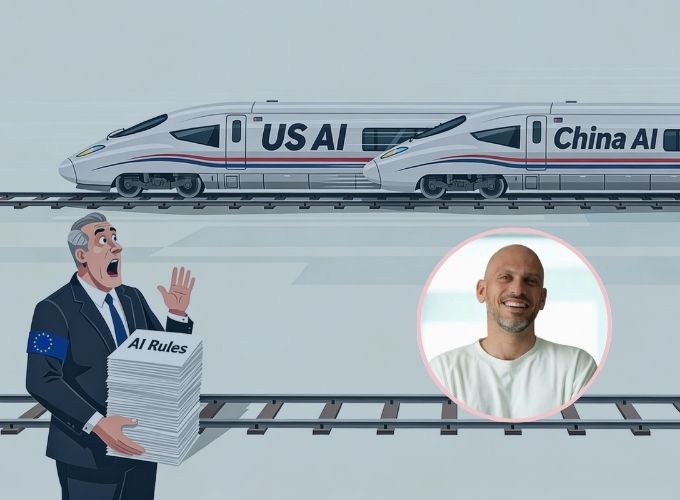
And while we are busy refining the rulebook, the game itself is being played elsewhere.
The United States and China are not having the same conversation. They are building. They are scaling. They are embedding AI into products, services and entire industries at a pace Europe simply is not matching. Their companies are shaping the tools that will define how work is done in the coming decades.
Europe, by contrast, is trying to ensure those tools are used responsibly.
That is not a bad thing. In fact, it is necessary. Someone has to set standards. Someone has to insist that a high-tech future still has people at its centre. I am firmly in the camp that believes Europe should be that someone.
But there is a difference to setting rules in a game you’re also playing when compared to one that you’re not playing at all.
Without a meaningful stake in the creation of these technologies, Europe risks becoming the geopolitical equivalent of a keyboard warrior — loudly debating, critiquing and prescribing from the sidelines, but with very little influence over how things actually unfold.
This matters because artificial intelligence is not just another technology cycle. It is a structural shift in how value is created. If machines can take on more tasks — not just repetitive ones, but cognitive, creative, decision-based work — then the question is no longer whether jobs will change. They will. The question is how societies adapt to that reality.
At the conference, there was a strong emphasis on keeping the “human in control”, on protecting workers, on ensuring transparency and fairness. All of that is valid. But it often felt like we were trying to manage the consequences of a transformation we are not fully participating in.
You cannot meaningfully shape the future of work if you are not also shaping the technologies driving it.
And right now, Europe has too few companies doing exactly that.
There are exceptions. France’s Mistral is often cited, and rightly so. It shows that Europe can produce serious AI players when the conditions are right. But one or two examples are not enough. Not when entire ecosystems are forming elsewhere, backed by capital, talent and a willingness to move fast.
If Europe wants to be more than a rule-maker, it needs to start thinking much more seriously about how to foster that kind of innovation at scale.
If machines are going to do more of the work, and they are, then the real question is how societies adapt. What happens when fewer people are needed to generate the same output? How are the gains distributed, and how do people earn a living when employment is no longer the primary mechanism?
There are ideas on the table — profit-sharing, shorter working weeks, new tax models, even universal basic income — but these are difficult conversations. It is far easier to regulate algorithms than it is to rethink how people earn a living. And so we risk focusing on the edges of the problem instead of its core.
To be clear, this is not an argument against regulation. Nor is it a dismissal of the work being done at European level. The discussions I sat through were thoughtful, necessary and, in many cases, forward-looking.
But they are incomplete.
Because without a parallel focus on building, on innovating, on creating the very technologies we are trying to regulate, Europe will always be one step removed from the centre of this transformation.
If Europe wants to be more than a rule-maker, it needs to start thinking much more seriously about how to foster that kind of innovation at scale.
You Might Also Like

Latest Article
Lazard Among Global Heavyweights Backing CrediaBank Share Sale
Some of the world’s most prominent investment houses are understood to have taken positions in CrediaBank’s latest share capital increase, signalling a strong long-term bet on the lender’s growth strategy across Malta and Greece. MeetInc understands that global portfolio managers including Lazard, Eaton Vance and Janus Henderson Investors were among those whose interest was … Continued
|
2 April 2026
Written by Yannick Pace
You Can’t Regulate What You Don’t Create
|
2 April 2026
Written by Yannick Pace
CrediaBank Share Sale Draws €1.1bn Demand In Strong Investor Vote
|
1 April 2026
Written by MeetInc.