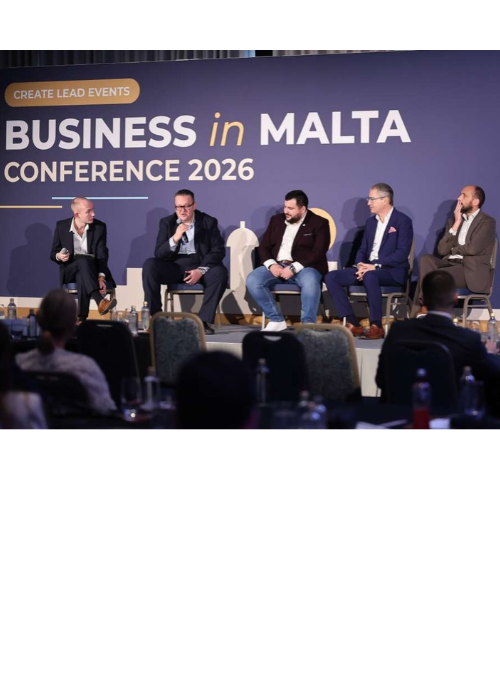
If more tourists visit Malta next year, should the country welcome the increase or be concerned? David Xuereb, Chairman of the Malta ESG Alliance, put that question to the opening panel of the Business in Malta Conference 2026 today. Visitor numbers tell the public how many people came, he argued but say little about what their visits contributed to the country.
Organised by Create Lead Events at the Hard Rock Hotel in St Julian’s, the discussion brought together four speakers to examine what works in Malta’s business environment and what needs to change. James Cummings, Business Editor at Times of Malta, moderated the panel.
Xuereb argued that Malta, like a business, needs to assess its performance over the medium to long term. He welcomed the fact that both Government and Opposition were debating whether the Budget would move Malta closer to its agreed goals. For Xuereb, that debate showed that sustainability had become a shared concern, even where views differed on how to achieve it.
Silvan Mifsud, Director of Advisory Services at EMCS, brought the discussion down to the level of individual businesses. In labour-intensive sectors, companies often try to grow by asking people to do more of the same work. Mifsud likened this to running faster on a hamster wheel. He urged businesses to examine how they operate, identify processes that could be redesigned and use technology where it would improve productivity. Too often, he said, the question of whether growth can be sustained comes only after a business has expanded. At a national level, such changes take longer than a five-year political cycle, making consistency in policy essential.
Wayne Pisani of Grant Thornton Malta argued that the limits of Malta’s infrastructure make it important to decide which industries the country wants to be known for. Shipping and gaming had each helped shape Malta’s international reputation. As digital capabilities become more important to investors, he called for investment in education and pointed to the clarity that English-language legislation offers businesses considering Malta. Regulation he added, should serve a clear purpose. Meeting a rule sets a minimum standard but businesses still need to ask what an investment will deliver over time.
Bernard Montebello, Director of Digital Innovation Enablement at the Malta Digital Innovation Authority, applied that same question to artificial intelligence. Before adopting AI he said, a business should identify the problem it wants to solve and how it will judge whether the tool has helped. Human judgement remains essential because a system can produce a result that does not serve the intended purpose. For a business deciding where to invest, Montebello’s advice was to start with the work that needs improving.
You Might Also Like
Latest Article
WHAT DOES MALTA GAIN FROM GROWTH? BUSINESS LEADERS CALL FOR A RETHINK
If more tourists visit Malta next year, should the country welcome the increase or be concerned? David Xuereb, Chairman of the Malta ESG Alliance, put that question to the opening panel of the Business in Malta Conference 2026 today. Visitor numbers tell the public how many people came, he argued but say little about what … Continued
|
19 November 2026
Written by Kim Vucinovic Cutajar
ONE IN TEN MALTESE WORKERS RISK LOSING SUPER BONUS OVER UNFILED TAX RETURNS
|
19 November 2026
Written by Yannick Pace
SPARKASSE BANK MALTA LAUNCHES CRYPTO-ASSET CUSTODY SERVICES
|
19 November 2026
Written by Yannick Pace