

There was a time when flying across Europe was still an occasion.
Tickets were expensive, national carriers dominated the skies and a short flight between two European cities could cost considerably more than the holiday waiting at the other end.
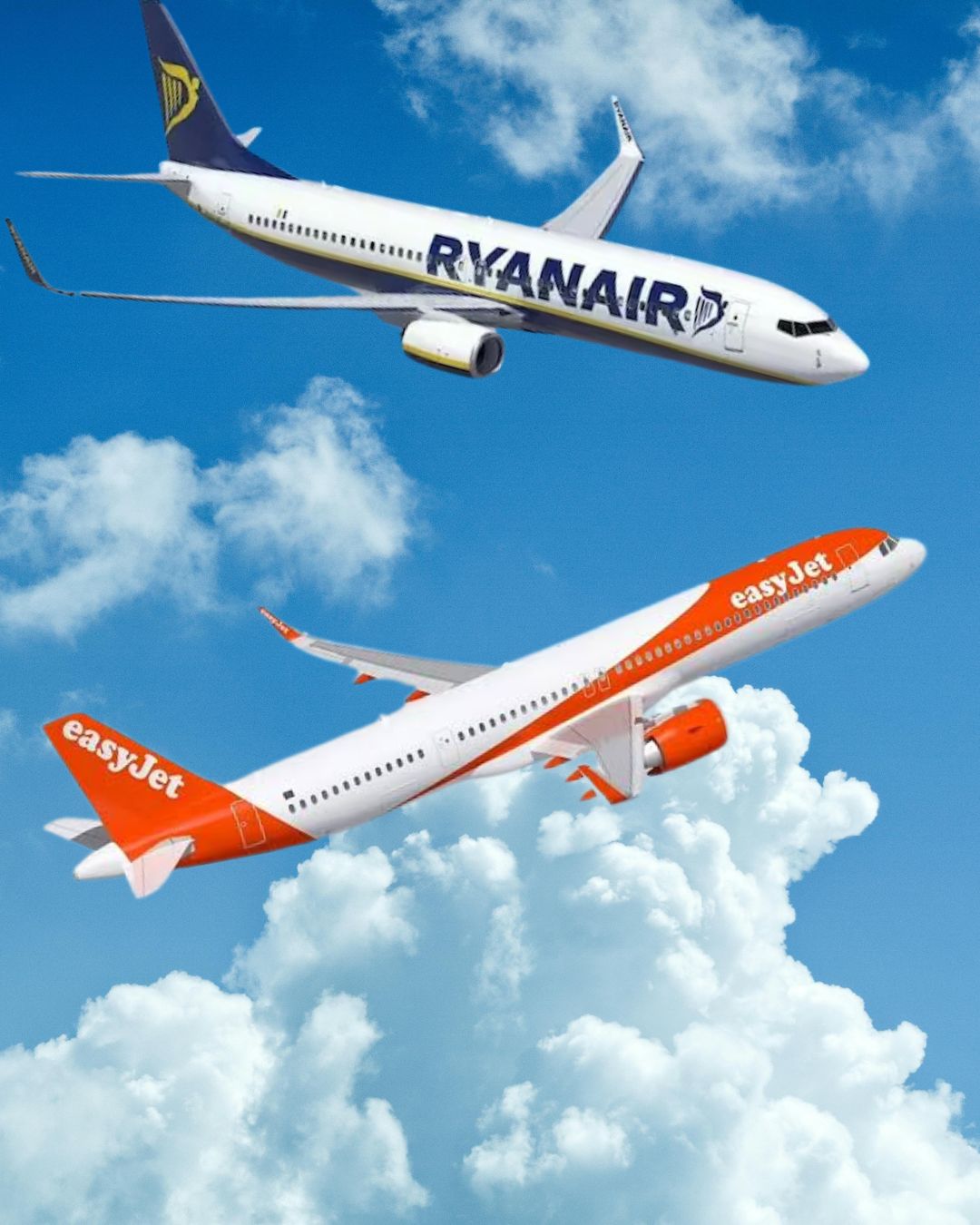
Then came Ryanair and easyJet.
Today, the two airlines are so deeply embedded in European travel that it is easy to forget just how disruptive they once were. Between them, the Irish blue-and-yellow giant and its bright orange British rival helped dismantle many of the conventions surrounding air travel and turned the weekend city break into an almost ordinary part of European life.
Yet despite frequently being placed in the same category, Ryanair and easyJet are remarkably different businesses.
Their origins, founders, corporate cultures and strategies tell the story of two very different approaches to winning the same war.
The Irish challenger that nearly failed
Ryanair’s story began in Ireland in 1985.
Founded by the Ryan family, led by aviation entrepreneur Tony Ryan, the airline’s first route connected Waterford with London Gatwick. The ambition was straightforward: challenge the dominance of established carriers on routes between Ireland and Britain.
The early years, however, were anything but a success.
Ryanair initially operated more like a traditional airline. It expanded rapidly, offered multiple aircraft types and attempted to compete directly with larger carriers. By the early 1990s, the business was struggling.
Enter Michael O’Leary.
Originally brought in as an adviser to Tony Ryan, O’Leary travelled to the United States to study Southwest Airlines, the carrier that had pioneered low-cost flying through ruthless operational simplicity.
The lesson was transformative.
One aircraft type. Fast turnarounds. No unnecessary frills. High aircraft utilisation. Secondary airports. And, above all else, low fares.
Ryanair did not invent the low-cost airline.
But it would become one of the model’s most aggressive practitioners.
Under O’Leary, the airline developed a corporate culture built around cost reduction with almost religious intensity. Anything that added complexity was questioned. Anything passengers might pay for separately became a potential revenue stream.
Food. Checked luggage. Priority boarding. Seat selection.
Even the possibility of charging passengers to use the toilet was publicly floated by O’Leary in 2009. He later admitted the idea was unlikely to happen, but acknowledged that it generated remarkably cheap publicity.
That, too, became part of the Ryanair model.
The Greek-Cypriot entrepreneur with an orange telephone
A decade after Ryanair’s first flight, another entrepreneur arrived with a remarkably similar ambition.
Sir Stelios Haji-Ioannou founded easyJet in 1995.
The son of Greek-Cypriot shipping entrepreneur Loucas Haji-Ioannou, Stelios was just 28 when he launched the airline from London Luton Airport.
Its first flights connected Luton with Glasgow and Edinburgh.
The marketing proposition was brilliantly simple: flying should be as affordable as buying a pair of jeans.
Early easyJet advertisements famously encouraged passengers to “fly to Scotland for the price of a pair of jeans”.
Where Ryanair’s personality would become inseparable from O’Leary’s combative public persona, easyJet presented itself as a youthful consumer revolution.
Its bright orange branding was impossible to ignore.
The airline famously displayed its telephone booking number across the side of its aircraft, turning the planes themselves into giant flying advertisements.
There were no travel agents.
Customers booked directly.
Seats were cheap.
The experience was basic.
For a generation of British travellers, easyJet made spontaneous European travel feel possible.
Same revolution. Different philosophy.
At first glance, Ryanair and easyJet appear almost identical.
Both operate short-haul, point-to-point networks. Both reject the traditional hub-and-spoke model associated with legacy carriers. Both rely heavily on high aircraft utilisation and ancillary revenue.
But their strategies gradually diverged.
Ryanair became obsessed with being Europe’s lowest-cost airline.
easyJet focused on becoming Europe’s leading low-cost airline at primary airports.
The distinction matters.
Ryanair built much of its growth around secondary airports, where landing charges were lower and local authorities were often eager to attract new passengers.
Paris could mean Beauvais.
Brussels could mean Charleroi.
Barcelona could, depending on the route, mean Girona.
easyJet was generally more willing to pay for access to major airports.
Gatwick. Amsterdam Schiphol. Paris Charles de Gaulle. Geneva.
The result was two different customer propositions.
Ryanair effectively told passengers: we will get you somewhere near your destination incredibly cheaply.
easyJet’s proposition was subtly different: we will give you a low fare while operating from many of the airports traditional airlines use.
That difference helped easyJet attract a greater share of business travellers and passengers prepared to pay slightly more for convenience.
Ryanair, meanwhile, built something extraordinarily difficult to compete with.
A cost machine.
The numbers tell their own story
The scale Ryanair eventually achieved is extraordinary.
In its 2025 financial year, the Ryanair Group carried more than 200 million passengers and generated approximately €13.95 billion in revenue.
easyJet, in its 2025 financial year, carried around 93 million passengers and reported revenue of approximately £10.1 billion.
Ryanair is therefore operating at more than twice easyJet’s passenger scale.
But the comparison becomes particularly interesting when profitability enters the equation.
Ryanair’s relentless focus on costs has historically allowed it to produce margins that competitors struggle to replicate.
Its decision to standardise much of its fleet around the Boeing 737 family simplifies pilot training, maintenance and aircraft scheduling.
easyJet has followed a similar logic with the Airbus A320 family.
Yet Ryanair has pushed operational efficiency further.
Aircraft are expected to spend as much time as possible in the air. Turnaround times are tightly controlled. Airport negotiations are notoriously aggressive.
The philosophy is simple.
An aircraft on the ground is not making money.
Michael versus Stelios
Every great corporate rivalry needs personalities.
Ryanair and easyJet had two of European aviation’s biggest.
Michael O’Leary built his reputation as the industry’s provocateur-in-chief.
He insulted competitors, mocked regulators and repeatedly generated headlines with ideas that ranged from standing areas on aircraft to toilet charges.
Sir Stelios, while hardly publicity shy, represented a very different entrepreneurial personality.
The contrast inevitably produced fireworks.
One of the most memorable clashes came when Ryanair published advertisements portraying Stelios as Pinocchio.
The campaign accused easyJet’s founder of hiding information about the airline’s punctuality.
Stelios sued.
Ryanair and O’Leary eventually issued an unreserved apology in the High Court and paid damages.
The episode perfectly captured the rivalry.
Ryanair attacked.
easyJet went to court.
O’Leary apologised.
And both airlines received enormous publicity.
The battle even extended to advertising about airports.
easyJet mocked Ryanair’s tendency to use airports located considerable distances from the cities passengers believed they were visiting.
Ryanair responded by asking advertising regulators to ban the campaign.
For companies built around removing unnecessary costs, both appeared remarkably willing to spend money arguing with each other.
Their biggest battles were sometimes internal
Ryanair’s most famous fights have often been external.
Governments. Airports. Regulators. Boeing. Trade unions. Competitors.
The airline also spent years attempting to acquire Irish rival Aer Lingus.
Its takeover ambitions were repeatedly blocked by European competition authorities, which feared the combination would severely reduce competition on routes to and from Ireland.
easyJet’s most dramatic battles, by contrast, frequently happened inside its own boardroom.
Stelios stepped down from running the airline relatively early but remained a major shareholder and retained ownership of the “easy” brand through easyGroup.
Over the years, he repeatedly clashed with easyJet’s management over strategy, executive pay and most significantly, aircraft purchases.
Those tensions exploded during the COVID-19 pandemic.
With global aviation effectively grounded, Stelios fiercely opposed easyJet’s multibillion-pound Airbus commitments.
At one stage, he offered a £5 million reward for information that could help cancel an order for more than 100 Airbus aircraft.
He also attempted to remove senior members of the airline’s board.
He failed.
But the episode revealed one of easyJet’s most unusual characteristics.
Its founder may no longer run the airline, but his presence has never entirely disappeared.
COVID: The moment the skies went silent
The pandemic represented the greatest crisis in modern commercial aviation.
For both airlines, passenger numbers collapsed.
Ryanair recorded a loss of more than €800 million during the crisis as traffic fell dramatically.
easyJet suffered even more profound disruption.
Aircraft were grounded. Thousands of jobs were placed at risk. The airline raised billions in additional liquidity and its balance sheet came under enormous pressure.
The crisis also exposed a crucial difference between the two businesses.
Ryanair entered the pandemic with one of the strongest balance sheets in European aviation.
O’Leary had spent decades building a company designed to survive price wars and downturns.
When travel returned, Ryanair moved aggressively.
Aircraft orders placed during periods of uncertainty allowed the airline to capture capacity as competitors struggled.
easyJet recovered too, but its journey was more complicated.
Its share price remained significantly below pre-pandemic levels and questions persisted about whether the airline was extracting enough profit from one of Europe’s most valuable short-haul networks.
easyJet finds another business
One of easyJet’s most interesting recent successes has not come from flying.
It has come from holidays.
easyJet holidays has grown rapidly by combining the airline’s network with hotels and packaged travel.
In some ways, the strategy represents a return to an older idea in aviation: the airline as part of a broader travel company.
The difference is that easyJet is applying modern digital distribution and its enormous customer base to the package holiday market.
Ryanair has largely remained more disciplined.
Its core product remains the seat.
Everything surrounding that seat is an opportunity to generate additional revenue.
The two businesses are therefore diverging once again.
Ryanair wants to carry an extraordinary number of passengers at the lowest possible cost.
easyJet increasingly wants to earn more from the entire holiday.
And now, another extraordinary chapter
Three decades after Stelios launched easyJet from Luton, the airline is once again at a crossroads.
In July 2026, easyJet’s board backed a £5.7 billion takeover proposal from US investment giant Apollo, trumping an earlier £5.5 billion approach from Castlelake.
If completed, the deal could take easyJet private after more than two decades on the London Stock Exchange.
The irony is difficult to ignore.
easyJet helped revolutionise European aviation.
It became one of Britain’s most recognisable companies.
It carried its 100 millionth passenger.
It built an enormous network of valuable airport slots and aircraft orders.
Yet today, investors are asking whether the company has ever fully converted those advantages into the profitability achieved by its greatest rival.
Ryanair, meanwhile, has become Europe’s largest airline by passenger numbers.
The company that nearly failed in the early 1990s now carries more than 200 million passengers a year.
So who won?
If the competition is measured purely by scale, cost and profitability, Ryanair is the clear winner.
Michael O’Leary took the low-cost airline model and pushed it to its logical extreme.
The result is one of the most efficient aviation businesses ever created.
But easyJet achieved something equally significant.
It made low-cost flying mainstream.
Its orange aircraft became part of European popular culture and its focus on major airports helped prove that budget aviation did not need to exist exclusively on the geographic fringes of major cities.
Perhaps the greatest legacy of both airlines is that an entire generation now considers international air travel ordinary.
A weekend in Rome.
A concert in Berlin.
A business meeting in Amsterdam.
A few days in Malta.
Trips that once required months of planning can now begin with a notification announcing a €29.99 fare.
Ryanair and easyJet spent three decades fighting over passengers, airports, advertising claims and the meaning of “low cost”.
In the process, they changed Europe.
The real winner was the passenger
You Might Also Like
Latest Article
Ryanair VS easyJet: The 40-Year Rivalry That Changed The Way Europe Flies
There was a time when flying across Europe was still an occasion. Tickets were expensive, national carriers dominated the skies and a short flight between two European cities could cost considerably more than the holiday waiting at the other end. Then came Ryanair and easyJet. Today, the two airlines are so deeply embedded in European … Continued
|
13 July 2026
Written by Kim Vucinovic Cutajar

California Startup Deploys Autonomous Robots To Reduce Pesticide Use By 70%
|
13 July 2026
Written by Yannick Pace
PwC Malta Renews Gold Sponsorship Agreement With The Malta Chamber
|
13 July 2026
Written by Kim Vucinovic Cutajar