
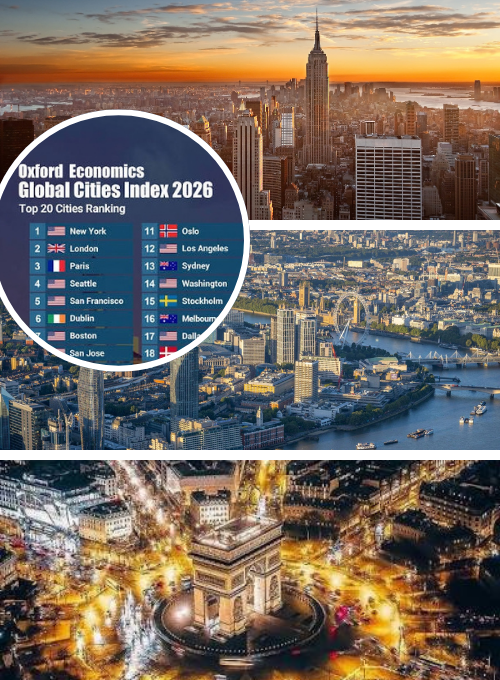


Oxford Economics has published its 2026 Global Cities Index, ranking 1,000 cities across five criteria and placing New York, London and Paris at the top of the global table.
The index scores cities against governance, economics, human capital, environment and quality of life. Seattle comes fourth, San Francisco fifth and Dublin sixth. Boston, San Jose, Tokyo and Zurich round out the top ten.
The findings identifies four qualities that the leading cities consistently share. The first is an ability to draw diverse talent. London places first in the human capital category, with foreign-born residents accounting for nearly 40 per cent of its population, a demographic breadth that has reshaped the city’s cultural and food offer in tangible ways. Boston ranks highly in the same measure, supported by its concentration of universities and a knowledge economy that channels investment into public spaces including the Rose Kennedy Greenway, a former elevated motorway transformed into gardens and public art.
Cultural investment is the second distinguishing thread. Paris, which performs particularly well on quality of life, has around 130 museums, with eleven municipal institutions offering free permanent-collection access since 2001. Seattle, which also scores strongly on quality of life, recently completed a 20-acre waterfront park on the site of a demolished motorway, adding community piers, cycling infrastructure and views across Puget Sound.
Environmental performance is the third factor. London’s congestion charge and Ultra-Low Emission Zone are cited as policies that have reduced car dependency across the city centre. San Francisco scores well in the same category through its transport network and Dublin has set a target of climate neutrality by 2030.
Technological momentum is the fourth quality. San Jose recorded the highest GDP per person in the entire index, driven by the presence of Alphabet, Apple and Nvidia in Silicon Valley. San Francisco, home to Meta, Uber and Salesforce, has integrated autonomous vehicles into everyday urban transport. Tallinn earns a place on the index’s Cities to Watch list, credited for its high AI adoption rate and its involvement in Rail Baltica, a cross-Baltic rail link due for completion by 2030 and designed from the outset as a fully digital railway powered by renewable energy and 5G infrastructure.
Taken together, the rankings reinforce that economic scale alone does not determine a city’s standing. Governance, environmental policy and sustained investment in culture each carry real weight in the final order.