
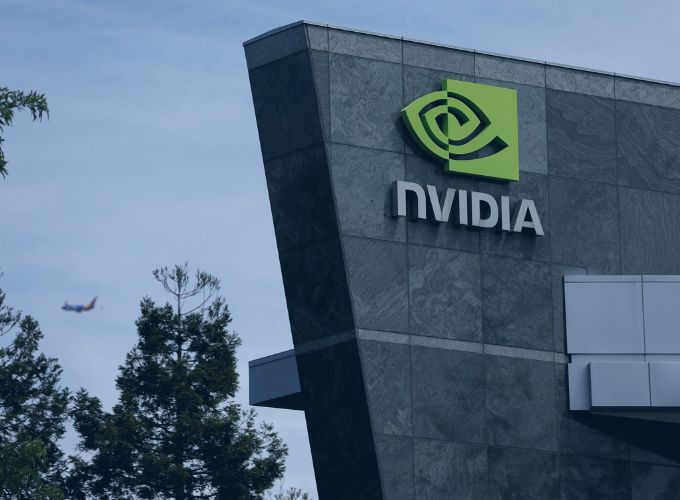


Nvidia has once again outperformed Wall Street forecasts with another quarter of blockbuster results, cementing its position as the world’s most valuable company. But despite record-breaking growth, concerns over its China business dragged down shares in after-hours trading.
The US chipmaker reported revenue of $46.7 billion for the quarter ending July 28, up 56% from a year earlier and slightly ahead of analyst expectations. Net income soared 59% to $26.4 billion, with earnings per share also beating forecasts. Nvidia has been the single biggest winner from the artificial intelligence boom, with its high-powered chips dominating the market for training and running large AI models.
Even so, investors appeared unsettled by uncertainty surrounding sales to China. Earlier this year, the Trump administration blocked exports of Nvidia’s H20 chip, a product designed for the Chinese market to comply with earlier restrictions. Nvidia later struck a deal allowing sales to resume — but only in exchange for 15% of revenues being redirected to the US government.
The arrangement still requires final regulatory sign-off, and Nvidia’s latest guidance did not include any H20 revenue from China. Its chief financial officer said the company could ship between $2 billion and $5 billion worth of H20 chips this quarter if approvals come through, but for now, revenue from China has plunged 25% year-on-year to $2.8 billion.
CEO Jensen Huang downplayed the risk, telling analysts that global demand for AI chips remains insatiable. He highlighted how four major “hyperscaler” tech companies — including Google and Amazon — have doubled their capital expenditure to a combined $600 billion per year. Huang said Nvidia’s next-generation Rubin GPU platform is on track to launch in 2026, with “millions and millions” expected to be deployed as governments and smaller cloud players join the spending race.
“The AI race is now on,” Huang declared. “We are building the essential infrastructure for the next era of computing.”
Nvidia’s data centre business, which powers AI applications across Big Tech, brought in $41.1 billion in revenue, slightly below forecasts, while its gaming segment performed better than expected. The company also authorised $60 billion in share buybacks, up from $50 billion last year, underscoring confidence in its long-term outlook.
Still, the results show growth has begun to slow compared to the astronomical pace seen at the start of the AI boom two years ago. With geopolitical tensions between Washington and Beijing ongoing, and Beijing reportedly encouraging Chinese firms to reduce reliance on US suppliers, investors remain cautious about how much of the Chinese market Nvidia can realistically capture.
Nvidia shares, which have already surged 35% this year, slipped 3% in after-hours trading following the earnings release. Analysts say the company’s future now depends on whether Big Tech continues its huge spending spree on AI hardware, and how quickly Nvidia can navigate the regulatory minefield surrounding China.
You Might Also Like

Latest Article
ITS Smart City Campus Targeted To Open In 2029, CEO Says
The Institute of Tourism Studies (ITS) is targeting 2029 for the opening of its new Smart City campus, a project that is expected to significantly expand the institute’s capacity and training facilities. The new campus will increase ITS’s student capacity from around 1,000 to approximately 2,500 students, reflecting growing demand for tourism and hospitality education … Continued
|
9 March 2026
Written by MeetInc.

CrediaBank Profit Surges As Bank Prepares For HSBC Malta Takeover
|
6 March 2026
Written by MeetInc.

NYSE Owner Backs MFSA-Licensed Crypto Exchange In $25bn Deal
|
5 March 2026
Written by MeetInc.