
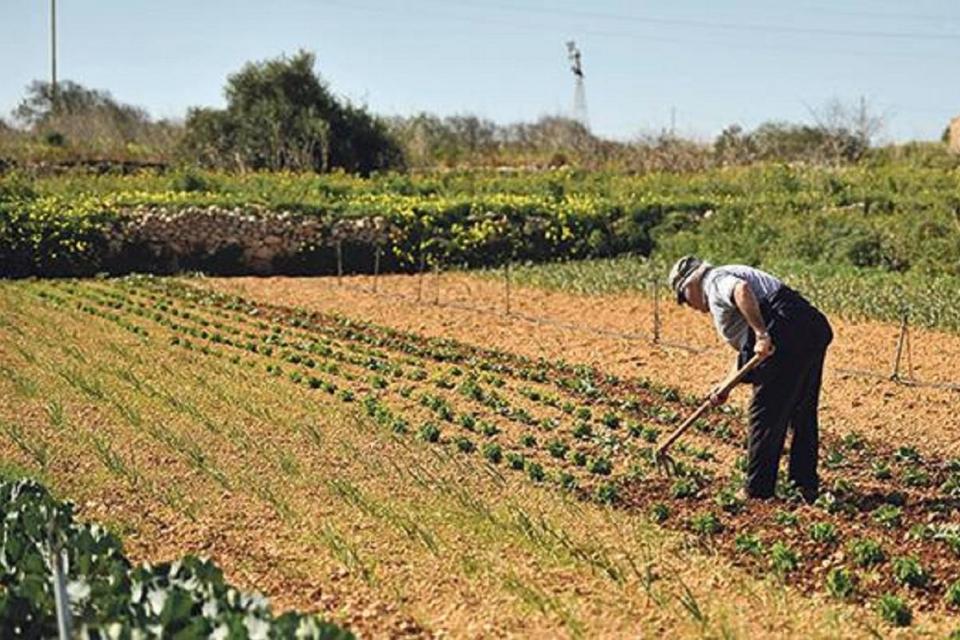


There are some 3,867 registered farmers in Malta according to data tabled in Parliament. The data was provided in response to a question raised by MP Julian Borg.
Of those, 1,052 were registered as full-time farmers, fully committed to the land as their primary occupation. A further 873 were registered as part-time farmers for whom agriculture nonetheless remains their principal source of income.
Taken together, that means roughly half of Malta’s registered farming population – just under 1,930 people – depend on agriculture as their main or sole livelihood. It is a meaningful proportion and one that gives a sense of how embedded farming still is in Malta’s working economy despite the island’s relatively small land area and the pressures of development and tourism.
The remaining 1,975 registered farmers hold principal employment elsewhere, with farming forming one part of a broader working arrangement.
That dual-income model is clearly not a marginal phenomenon – it accounts for more than half of all registered agricultural workers and suggests that part-time farming plays a significant structural role in how rural and semi-rural households in Malta organise their income.
Whether that reflects economic resilience, opportunity, or necessity is a question the data alone cannot answer, but the scale of it is notable.