


Apple will not be subject to the US government’s forthcoming 100% tariffs on imported semiconductors and chips, after the company announced it was increasing its US investment by an additional $100 billion.
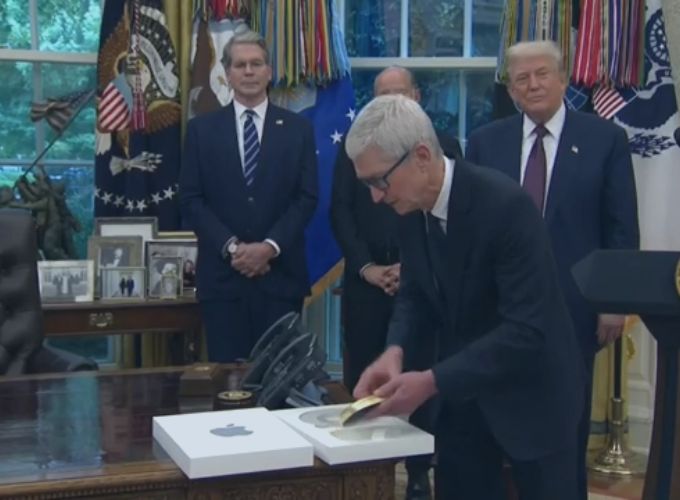
The news was shared during a ceremony at the White House on Wednesday, where Apple CEO Tim Cook joined President Donald Trump to highlight the tech giant’s domestic manufacturing efforts. Apple is expanding its previous pledge to invest $500 billion in the US over four years to $600 billion.
Trump said the tariff exemptions would apply to companies “building in the United States” or those that have committed to doing so. “The good news for companies like Apple is if you’re building in the United States, or have committed to build, without question, in the United States, there will be no charge,” he said.
As part of its investment push, Apple said that soon 100% of all cover glass for iPhones and Apple Watches will be produced domestically.
The president was presented with a commemorative gift made from US-manufactured materials, including Apple-produced glass from Kentucky and a 24-karat gold base from Utah. Cook said the gift was designed by a former US Marine Corps corporal now working at Apple.
Despite the tariff exemption on chips, Apple may still be affected by other elements of the administration’s evolving trade policy. Trump has recently imposed additional tariffs on Indian imports in response to the country’s continued purchases of Russian oil. India plays a growing role in Apple’s global supply chain, and it is unclear whether the company’s operations there will be impacted by the new measures.
Apple said during its most recent earnings call that tariffs cost the company $800 million last quarter. That figure is expected to rise to $1.1 billion in the current quarter ending in September.