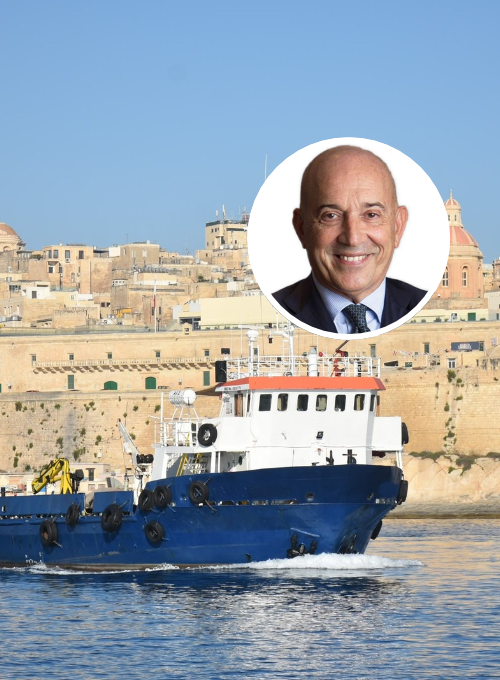


Emanuele Grimaldi, managing director of the Grimaldi Group, has branded the EU’s Emissions Trading System for shipping “totally insane” and “a tax that every Maltese citizen is paying”. He said the money raised under the scheme had been collected “unlawfully and against the interest of the European citizen”.
The burden, he argued, lands on Maltese consumers. “It’s a tax that every Maltese citizen is paying for receiving and for exporting material… It’s total madness and should not be applied at all,” he said.
Launched in 2005 and later widened to cover aviation and shipping, the ETS is meant to curb carbon emissions and steer investment towards greener operations, with the proceeds funding modernisation and decarbonisation. Grimaldi called it a “big mistake” to run the scheme regionally. In his view, the system, which forces operators calling at EU ports to buy allowances for their carbon emissions, should have come through the International Maritime Organisation as a global measure.
Pushed on whether a worldwide deal was ever feasible amid US-led resistance to climate policy, he conceded that US President Donald Trump had leaned on the IMO “very much not to find an agreement”. “But, in the end, what counts is also the number of countries that agree on the issues and I think we all have to take responsibility,” he said, adding he was “sure” China would have backed a global equivalent.
He also challenged the scheme’s legality, saying the EU had no business taxing fuel burned in Chinese waters or the Red Sea. By his estimate, a “maximum” of 10% of the money collected goes towards retrofitting fleets to cut emissions. The European Commission puts last year’s ETS revenue at over €43 billion, directed to industrial and transport decarbonisation, climate adaptation, renewables and energy efficiency.
On the strains hitting the sector, after Iran shut the Strait of Hormuz in the wake of US and Israeli strikes, Grimaldi said shipping had held up but the episode had dented its appeal to workers. Many seafarers were hurt, he said and that was part of why crews were getting harder to recruit. The International Chamber of Shipping reported this year that the industry is short of roughly 39,000 officers.
For today’s recruits, Grimaldi said, staying online counts for more than a bigger pay packet. “Today, the number one issue that seafarers want is to be connected. Young people cannot live without their phone and their connection.” He pointed to “two very good schools in Malta” running maritime training and to the openings created by the local fleet, which he described as “by far the biggest fleet in Europe”. The group has deals with Maltese schools to place cadets aboard its ships.
Newly installed as president of the Malta International Shipowners Association, which he helped set up in 2004, Grimaldi said his aim was “continuous growth of quality and good interlocution with the government”. He credited Malta’s register with a strong reputation as a “clean white flag”, a standing that had fuelled its expansion. The register now carries more than 10,800 vessels with a combined capacity of over 94 million GT.