

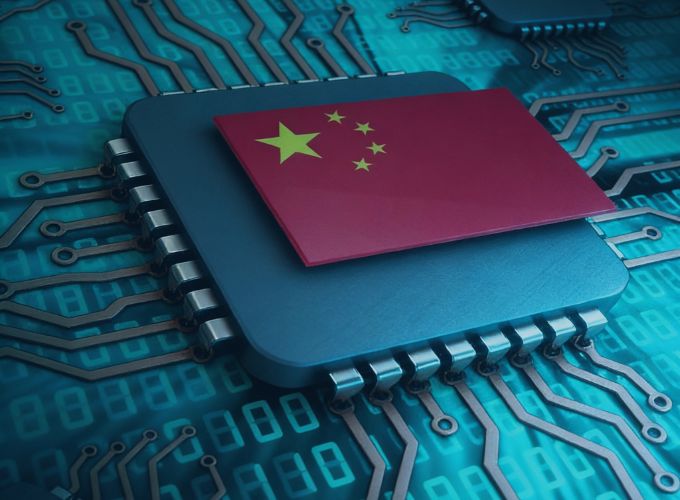


China appears to have achieved a major breakthrough in one of the most complex technologies underpinning modern computing: extreme ultraviolet (EUV) lithography — a capability long considered essential for producing the world’s most advanced semiconductors and AI chips.
For years, Western governments, chipmakers, and analysts maintained that China was at least five to ten years away from mastering EUV technology. Over that period, the U.S. and its allies imposed sweeping sanctions and export controls designed explicitly to prevent China from accessing EUV machines and the advanced chips they enable. The latest reports suggest that gap may have closed far faster than anticipated, raising profound implications for global semiconductor supply chains, artificial intelligence development, and technological power balances.
EUV lithography is the process that allows chipmakers to etch incredibly small transistor patterns onto silicon wafers — features measured in nanometres. Without EUV, producing cutting-edge processors used in advanced AI models, high-performance computing, and next-generation consumer electronics becomes extremely difficult, if not impossible.
Until now, the technology has been tightly controlled. The Dutch firm ASML remains the world’s only commercial supplier of EUV machines, each costing over €150 million and containing tens of thousands of components. Under U.S.-led export restrictions, ASML has been barred from selling EUV systems to China, a move intended to slow Beijing’s progress in advanced chipmaking.
China’s apparent breakthrough raises the possibility that those controls may have had the opposite effect: accelerating domestic innovation rather than containing it. Without access to Western suppliers, China appears to have doubled down on developing its own EUV capabilities — something it may not have prioritised as urgently had continued access to ASML’s machines remained an option.
While details remain limited, Chinese researchers are reported to have developed a working EUV-capable system — not necessarily identical to ASML’s machines, but functionally capable of producing advanced chip structures. If scalable, this would allow Chinese fabrication plants to move closer to producing chips at 7 nanometres and below, a threshold crucial for competitive AI accelerators and data centre processors.
The implications extend well beyond consumer electronics. Advanced chips form the backbone of modern AI systems, military technologies, autonomous platforms, and high-speed communications. Removing dependence on foreign EUV suppliers eliminates a critical bottleneck that has constrained China’s ambitions in artificial intelligence and supercomputing.
For global markets, the development adds a new layer of uncertainty. Semiconductor leadership has become a strategic asset, shaping industrial policy, trade restrictions, and national security strategies across the U.S., Europe, and Asia. A China capable of independently producing EUV-class chips could reshape pricing power, supply resilience, and long-term investment flows across the industry.
It also raises uncomfortable questions for Western policymakers. Export controls were designed to buy time — slowing China’s technological advance while domestic chip manufacturing capacity was rebuilt elsewhere. China’s progress suggests that time advantage may have been far narrower than assumed.
While major challenges remain — including yield optimisation, mass production, and ecosystem maturity — the symbolic importance of cracking EUV technology is difficult to overstate. What was once framed as a distant milestone now appears significantly closer.
The semiconductor race is no longer just about factories and funding. It is about who can solve the hardest engineering problems first — and China has just signalled it is far more competitive in that race than many believed.
You Might Also Like
Latest Article
ITS Launches 2026–2027 Prospectus As Tourism Skills Demand Grows
Institute of Tourism Studies (ITS) has launched its academic prospectus for the 2026–2027 academic year, outlining an expanded range of programmes aimed at meeting the evolving needs of Malta’s tourism and hospitality sector. The prospectus covers a wide spectrum of qualifications, ranging from foundation-level courses to postgraduate degrees, reflecting the institute’s role in developing talent … Continued
|
15 April 2026
Written by MeetInc.

Victoria 2031 Invites Cultural Proposals As Final EU Selection Nears
|
14 April 2026
Written by MeetInc.

VDH Group Offloads Polish Hotel In €15.7m Portfolio Move
|
13 April 2026
Written by MeetInc.